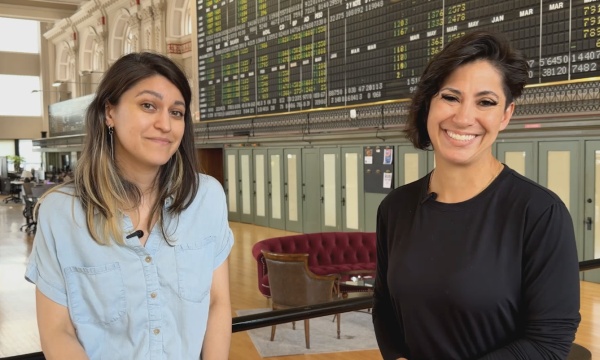
Welcome back to the Government Video Podcast. I'm your host, Michelle Alimoradi. We're bringing you a special extra episode of the podcast this week, featuring an inside look at the National Association of Broadcasters East Coast event, NAB Show New York. We've covered NAB in the past on the podcast, and based on your streams and downloads, those have been some of your favorites. favorite episodes. So we didn't want to miss the opportunity to bring you the latest news directly from the show floor as NAB made their way to our backyard. So last week, the GVP team gathered at the Javits Convention Center along the Hudson River in New York City to chat with some of our favorite vendors and operators and learn about some of the up and coming trends in the industry. Today, we're bringing some of those conversations directly to you. And we think you're going to want to stick around to the very end because a lot of what we've talked about directly benefits folks who are using video to expand resident services in local media and local government service delivery. So let's get into it. My first interview was with Andrew Levison from Community Media of Staten Island. CMSI recently adopted Cablecast Automation solutions to distribute video to cable and streaming platforms. In our conversation, we talked about how CMSI's new workflow includes a more streamlined way to bring live remote productions to their viewers, and how access to viewer metrics has helped his team understand what's going on. What his community likes to watch. They've used that information to decide where to invest when it comes to expanding their community coverage. Let's listen to that conversation now. We're here at NAB New York, and we just ran into Andy. From community media of Staten Island. And Andy, what did you come here to discover at NAB today? Well, what we're doing upgrades to our small studio. So we're researching PTZ cameras. So I knew TriCaster switching system, uh, intercom systems. We are working much more live from the field thanks to Cablecast. We have live view systems going into our Cablecast system now. So we are getting a lot of viewership through Cablecast for live production for the first time from the fields. So that's a very exciting thing for us. So we're looking to just grow that. Because we found, through the audience measurement of Cablecast, that the biggest viewership that we get is from local high school sports. We are continually being surprised at the benefits that the Cablecast system has given us, because we had never streamed before. So, uh, being able to provide a live and video on demand. And be able to measure exactly what's working, lets us tune into our community and see what really the community wants to see. We can almost measure, it's almost as if we have our own People's Choice Awards, but Cablecast is letting us know what those are. That's awesome to hear, Andy. I'm glad that, you know, folks are really finding that content so engaging and that it really has legs so far into the, into the future. Yes. Um, so the themes are more live. More remote. Yes. Um, was there anything that you were surprised by, uh, when you came to the show today? It seems that the ability for remote engineering is really advancing. So, um, being that we have a very low budget, Uh, we are now working with an engineer who works mainly remotely. And so all the equipment we're looking at now, uh, whether it be the intercoms or any other, uh, the audio mixers through camera switching that, uh, the latest technology allows the engineer to access that equipment, diagnose it, change settings. And troubleshoot all remotely. So for us with such a low budget and not being able to maybe afford a excellent engineer in house, this is something where we can just tap into him 10 minutes here, 10 minutes there per week. And that technology was not available that long ago. And now we can get great help at a price we can afford. And I love to see small teams like trying to latch on to this latest technology and really trying to do. The most with limited resources. Cause I think some people just kind of, they give up, they just say like, Oh, we're a small team. Oh, it's a small budget. So we're just gonna, you know, not, not try to give it our all and not try to push the system, you know, to, to the best of its ability. And you guys are really getting out there. And doing the most of we love to see that. Yeah. I mean, I think that comes through leadership. And so who are you working with when you talk about leadership? Is this a cable board? Are you working with the borough? Yes. I mean, we are the public access station for Staten Island, New York. So our executive director, our board president, and then we have a board members, but they are going basically with the recommendations of the board president and an executive director. So it's their commitment to. To taking us into the future, which is brought all these changes in just a year and a half. I mean, a year and a half ago, we were not streaming. We just were installing the cable cast system. And so we've only been streaming and video on demand since September of 2023. So we are very new to this and it's very exciting. And people are downloading our apps. And it's just a whole new world for Staten Island to care about community health. It's awesome. And it's great to hear that, you know, you have that gratification, you have the ability to see the data and know that what you're doing is paying off. You'd love to see that. It's been such a huge improvement in serving our community audience in Staten Island, New York. The cord cutting is continually happening with cable and people are only streaming. Not only are we not losing our audience, our limited audience on cable, but now we're expanding to well beyond the borough of Staten Island. To anybody who cares about Staten Island, wherever they may be for anybody in the community media world, it is well worth the launching into this, you know, the streaming worlds, uh, with video on demand and through all the apps, the iPhone app, Android phones, Roku TV player, Amazon fire player, Apple TV player, and I'm sure any community access who has not yet migrated to streaming, it would be world changing for them. Yeah. Definitely. Well, thank you so much, Andy. I appreciate you. Enjoy the rest of the show. My next interview is with Mike Nahn from Magewell. Mike and I have worked together in different capacities over the years, and I've really come to value his perspective on where the industry is headed, because Mike always has his eye on all aspects of video and broadcast technology, including the demographics of folks working in the industry and the way that it's been changing over the last decade. Let's listen as we dive into the details of what Magewell is focused on in the near future, as well as Mike's personal observations on the show floor this year. I'm here with my friend Mike Nahn, who is currently with Magewell in their booth, but you do a lot of things. Tell us about what you do, Mike. Well, technically I work for Magewell's U. S. distributor, MVD. We also carry a lot of other brands that support the ecosystem of what Magewell does. And you know, Magewell's in production and streaming, so we also have things like cameras, network. Bonding and that sort of thing to really help bring the whole streaming ecosystem together. And tell us about some of the themes that are coming up in the conversations that you're having with folks here at NAB New York this year. Sure. I mean, one of the things that really struck me was even when we're talking about some of the bigger agencies, bigger production companies, government agencies, schools, that sort of thing. They're really embracing more of the content creator mindset, the same, you know, YouTuber TikTok type mindset. When we started talking to a lot of those people about production before, it was very formal how they were. But they're starting to realize now their audience, you know, it resonates with them in a different way. So they're starting to think more of the running gun type productions, or the podcasts, or that sort of thing. Making it a little less formal, less like a corporate webcast, and more like these short, bite sized pieces of content. And that's actually driving a lot more people towards production and streaming, because it's not so formalized anymore, right? Now, you know, a teacher can take on some of this himself without going through the AD department, things like that, and we're seeing a lot more of that in this show. So things like live streaming, remote production, doesn't seem as, like, intimidating as it used to seem before, that's kind of the go to at this point, is that what you're saying? That's what, exactly, and I mean, I think a lot of it is, one of Mageworld's missions, we always wanted to do this technical invisibility, we called it. Where the technology is so easy to use and so pervasive, you forget you're using the technology. And it used to be that it was something like streaming, you know, people felt they had to learn a lot to be able to do it. Now they're at the point where they can just pick up some of these really intuitive tools and just start going right away, and it's no longer an impediment to the creative process, it's part of the creative process. No, I agree. I mean, the setup that we're using right now is we were just talking about before we started recording, like this bit in my pocket, what I brought with me today, and it's not, you know, it's not this robust. Thing that, you know, a lot of networks would use, but it gets the job done, you know, and we're, and we're portable and we're live and we're remote. So I love that. I love to hear that. Any other takeaways that you've got from the past two days here? Well, I mean, the one thing, I mean, for our own products and stuff, it's just been a natural fit because as I said, so many people are more into the streaming. One thing, you know, now that people have the production tools that we're seeing a lot more demand for, well, you have to get to get this out. If you're doing it live, you need a great internet connection and, you A trade show environment is actually a perfect place to explain the problem. Because you can pay a whole lot for a direct connection from the show itself, but if you want to use your cell phone or that sort of thing, performance can go up and down, Wi Fi congestion, things like that. So a question we've been getting a lot of is, well now, how do I get my stream out there reliably? And we have a partner company that we deal with at MVD called Miri, and they're a partner of Magewell as well, and they have a solution for that. And that's been one of our most popular things because it bonds. All sorts of different poor connections together into one fantastic connection to be able to do that. So this bonded cellular remote connection is getting better and better every year as well. Better and better and easier and easier and more flexible. I mean, a lot of the original solutions that solve this problem use proprietary protocols. This will take, you know, 4G, 5G, Wi Fi, wired, Starlink, combine it all and you can put any kind of data over it. I mean, it could be financial transactions or social media posts or that sort of thing. It doesn't have to be video. It's that open. And we put traditional camera batteries, the same Sony batteries that will go on a camera, can power it too. So you can just throw in a backpack and take it out in the field with you. That's awesome. And what about, what about budget conscious folks like our folks at cities? Um, you have limited budgets or they have, you know, a long approval process to adopt new technology. Is this looking more accessible for folks like that? Well, absolutely. And I mean, again, that's very specific in some ways to where Magewell fits in the market in Mirri as well, because the whole idea was to make this accessible to organizations, large and small. So, you know, we didn't come out at the 5, 000 encoder level. We came out at the 500 encoder level, that sort of thing. So we were always very conscious of making these things accessible, you know, small independent producers as well, not just the big production companies. We have some higher end products as well, but we want to make sure we always serve the broader market that can afford these. Even, you know, churches are another great example, churches, government agencies, small schools, all of it. We've got something that can fit their budgets. Awesome. Next, I had the chance to connect with our friend Jefferson Pichinte at Teradek to talk about reliable video streaming from the field. I have personally talked to so many municipal video operators who are utilizing Teradek solutions for live remote meeting coverage, including Brady Wurtz at Campbell County who recently sat down with us on the podcast to give us a point by point breakdown of his live remote workflow covering live meetings for 11 different cities. If you haven't listened to that episode yet, it's been one of our most popular. Be sure to add that to your queue after this one. Now, With more cities looking to broadcast live from remote locations, solutions like Teradek's bonded network solutions can provide the stable connection you need to get the job done. Let's listen to some more details and real world examples from Jefferson right now. I'm here with Jefferson of Teradek, and we're talking about. IP video delivery. Tell us a little bit about what you guys do and what you're showing off here. Yeah, absolutely. So we're a company that manufactures encoder and decoder solutions in primary for like the live streaming, remote productions or live streaming out to online platforms like Facebook, YouTube with the core contribution to like platforms like Cablecast. So contribution encoders primarily. And what has been coming up for you sharing conversations at NAB New York this year? What's new? Yeah, sure. So we've gained a lot of. Cities wanting to stream reliably from the field back to the control room. So one of the solutions that we offer is network bonding encoders. So the ability to be able to stream reliably from the field to the control room with reliable internet connections. So that allows them to get video quickly for their social media team or online platforms. Have there been any particularly interesting projects that you've seen city departments working on with your product? Yeah, let me get one from the file, okay? We do work with a lot of law enforcement in cities, but I think one that stands out quickly is Contra Costa uses our equipment to do contributions to Cablecast, actually. So, you know, it's just a big role that we play in just contribution. So, Really, any city or law enforcement company that needs high quality, low latency video is the main role that we play. That's awesome. Um, and then just for you personally here at the show, walking around, is there anything that you've noticed, that you're surprised by, anything? What I'm noticing is a trend of people wanting quick content. So I think that's where we play a big role is just having that reliable connectivity on the ground because I believe that is really the foundation of streaming. So if you don't have a good internet connection, I feel that it's not going to be as fast as you want it. So if you want that, then, you know, we have a product called Prison Mobile. Just, you know, putting in my little pitch there. And then that is a solution that we're offering. Yeah. People want to be light. People want to be flexible. They want to be remote. And you guys help them get there. That's really great. Well, thank you so much Jefferson. We appreciate you coming on the government video podcast. Thanks for stopping by. I appreciate you guys. And with that, we're wrapping up this special episode of the Government Video Podcast. We hope you enjoyed this inside look at NAB's show New York. It's amazing to see all the cutting edge technology that's now becoming more accessible to cities. Whether it's live streaming high school sports or city council meetings, the right tools can help you serve your community better, and we're here to help you stay up to date. If you found this episode helpful, make sure to subscribe, leave a review, and please share it with your colleagues. Thanks again for tuning in. I'm your host, Michelle Alimoradi, and we'll see you next time on the Government Video Podcast, where we bring you the latest on video and streaming, media accessibility, gear, broadcast workflows, and more for municipal communicators. Special thanks to our videographer and editor, Maria Calvo, and we'll see you next time.